What is strategic finance for payments companies?▾
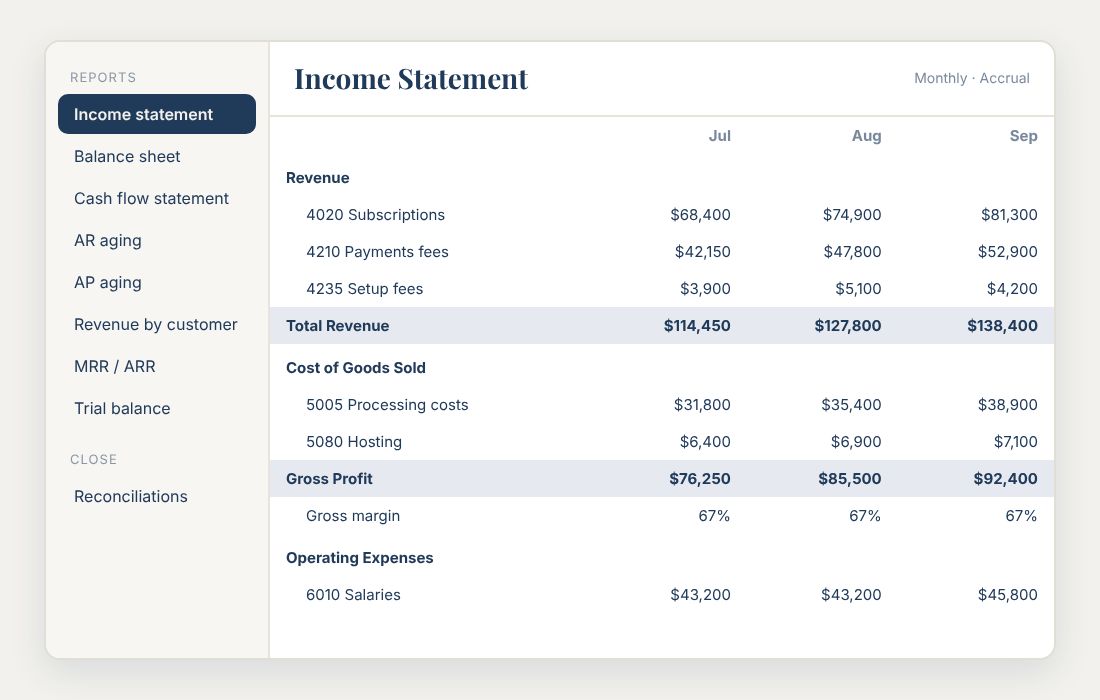
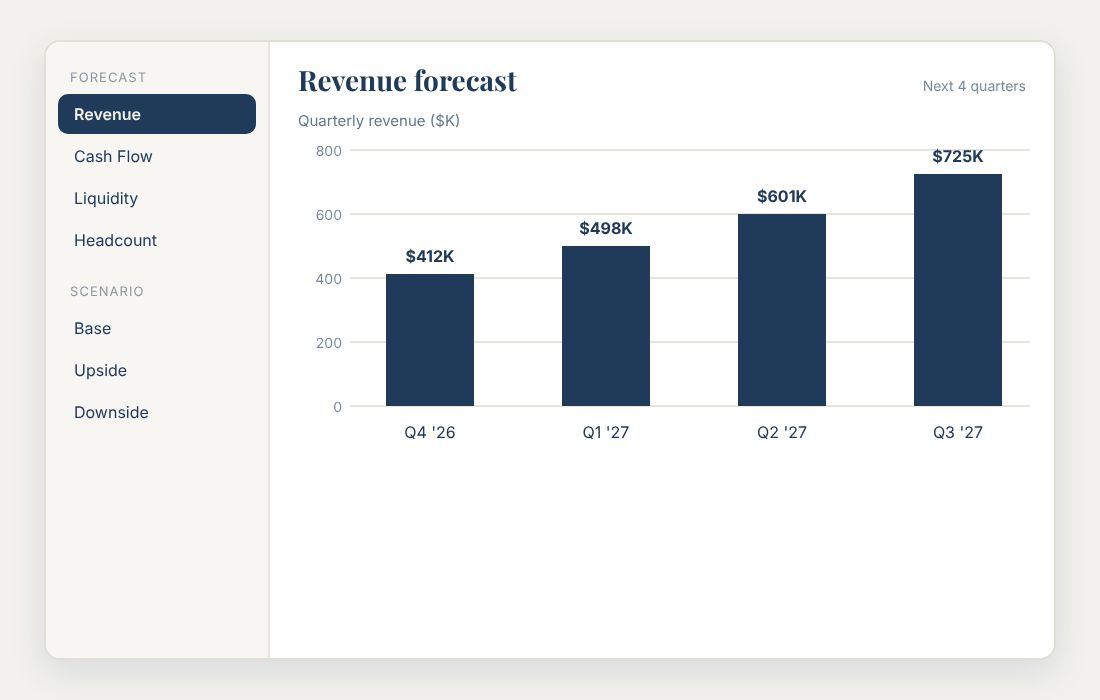
Strategic finance for payments companies is the work of forecasting cash, modeling revenue, and analyzing unit economics when income comes from payment volume, software subscriptions, or both. Bridges delivers it as a rolling 12-month forecast, unit economics by revenue stream, and monthly metrics, led by Tim Salikhov as CFO. It is built for vertical SaaS companies, B2B platforms, and fintechs with $3M to $30M in revenue that process payments through Stripe.
How do I forecast cash when payments are part of my revenue?▾
Split revenue into subscription, usage, and payment streams and forecast each on its own driver: renewals, metered usage, and customer payment volume. Take interchange and Stripe fees out of payment revenue before it reaches margin. Then run strong, base, and slow volume cases so your customers' seasons and payout timing show up as a range of cash outcomes.
Should payment revenue be recorded gross or net?▾
It depends on whether you control the payment service before your customer receives it, not simply on who holds the money. Holding funds, even briefly, doesn't settle it. If you act as the merchant of record, run the payment flow, and set the pricing, as a payment facilitator does, you usually book gross. If you mostly refer customers to a processor, you usually book net. Gross profit is the same either way. Your accountant and auditor make the call.
What take rate should a software or payments platform earn on payments?▾
Net take rate is revenue from payments minus interchange, processing, Stripe, and other pass-through costs, divided by payment volume, in basis points. Companies with referral models tend to net 0 to 20 bps. Companies processing payments can net 40 to 90 bps on managed PayFac models, and 100 to 120+ bps for registered payment facilitators, moving with card mix, ticket size, and vertical.
When does a company that earns on payments need a dedicated strategic finance function?▾
The need shows up when payment complexity increases, typically with addition of new revenue streams or pricing models, as well as when payment volume moves monthly cash away from what the subscription plan predicts. Common triggers are a hiring plan that outruns the cash forecast, a sales team build, a fundraise or debt facility, and a cash miss two quarters in a row. Any one means the plan needs a model that treats payment revenue and processing costs as their own lines.
How do you forecast revenue for a payments infrastructure company?▾
Forecast payment volume by customer, multiply by net take rate, and subtract processor and network costs. Add any software or platform fees as a separate line. Run the model with revenue booked gross and net so investors see both. Settlement timing and reserves belong in the cash forecast, not in margin.
How much do strategic finance services cost?▾
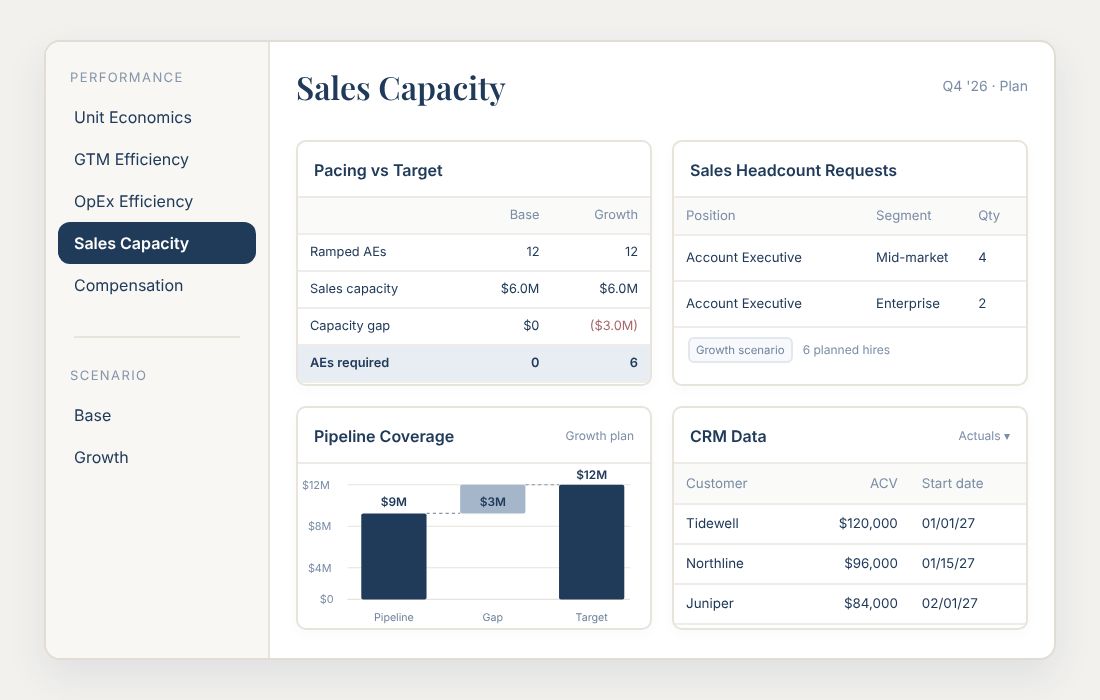
Strategic Finance starts from $10,000/month and includes all of Cash Management with deeper analysis: models, scenarios, department budgets, rolling forecasts, and sales capacity and quota planning. Cash Management starts from $5,000/month and includes cash, runway, metrics, annual planning, and flux analysis. Cadence is monthly in Cash Management and bi-weekly in Strategic Finance. Board and investor reporting belong in the Fractional CFO engagement, starting from $15,000/month. Monthly engagements begin with three months, then continue month to month. We bill on the 1st. After the initial term, cancel with 30 days' notice. The initial model build, chart of accounts rebuild, and accrual rebuild are included. There is no onboarding fee.