
Payments Risk & Compliance for Vertical SaaS: What You're Actually On the Hook For
Embedding payments means inheriting risk. Here's what each model actually transfers — and what stays with you.
The moment you embed payments into your SaaS product, you inherit risk that most founders only fully understand after something goes wrong. A merchant's chargebacks spike. An account gets frozen on a high-revenue day. A sub-merchant turns out to be running a business your platform shouldn't have touched. These aren't edge cases — they're the normal failure modes of a payments integration that was evaluated on price and speed but not on liability. This guide maps the full risk landscape, explains what each payment model actually transfers and what it doesn't, and gives you the math to make the right structural decision.
- Friendly fraud now accounts for 45%+ of all chargebacks — initiated by your actual customers, not fraudsters — and it counts against your chargeback ratio exactly the same as stolen-card fraud. Clear billing descriptors are the single cheapest defense.
- PFaaS (Stripe Connect, Adyen for Platforms, Finix) transfers financial and regulatory payment infrastructure risk to the provider, but your platform retains tax obligations, merchant intake quality, data handling, and acceptable use enforcement.
- Full PayFac registration requires $330K–$790K/year in ongoing compliance infrastructure and only makes financial sense above $100M–$150M in annual GMV.
- Visa's VAMP program is tightening its "excessive" chargeback threshold to 1.5% in April 2026. A prudent internal red line is 0.9%.
- HIPAA and PCI DSS are two separate regimes that both apply simultaneously to healthcare platforms. Full PCI compliance does not satisfy HIPAA.
Part 1: The Full Risk Landscape — What Facilitating Payments Actually Exposes You To
Before choosing how to structure your payments, you need to understand what you're choosing between. Below is the complete set of risk categories any platform facilitating payments must account for. None of them disappear by choosing a particular provider — what changes is who owns each one.
Fraud risk
Fraud risk is the exposure from unauthorized or deceptive transactions on your platform. The categories that hit vertical SaaS platforms hardest:
Friendly fraud (first-party misuse) is now the dominant category, accounting for 45%+ of all chargebacks and climbing. A cardholder disputes a legitimate charge with their bank rather than contacting your support team. For subscription platforms, this is usually a customer who forgot about a recurring charge and called their bank instead. It counts against your chargeback ratio exactly the same as stolen-card fraud.
Card testing targets any flow that lets someone validate a stolen or synthetic card cheaply — most relevantly, free trials requiring a card on file. Bots run thousands of card numbers through small-value authorizations in hours. Even failed attempts cost authorization fees and can trigger network fraud-monitoring enrollment.
Account takeover (ATO) is the fastest-growing fraud category. Fraudsters target accounts that already passed KYC because it lets them bypass onboarding scrutiny entirely. Credential stuffing is the dominant vector.
Synthetic identity fraud — fabricated identities blending real and fake data — is the fastest-growing form of financial crime by dollar volume and is specifically designed to pass standard KYC checks. It matters most for platforms doing their own merchant underwriting.
Business email compromise (BEC) uses social engineering to trick your team or your merchants into authorizing wire transfers or payment changes to fraudster-controlled accounts. Platforms that handle payout configurations are particularly exposed.
Return and chargeback risk
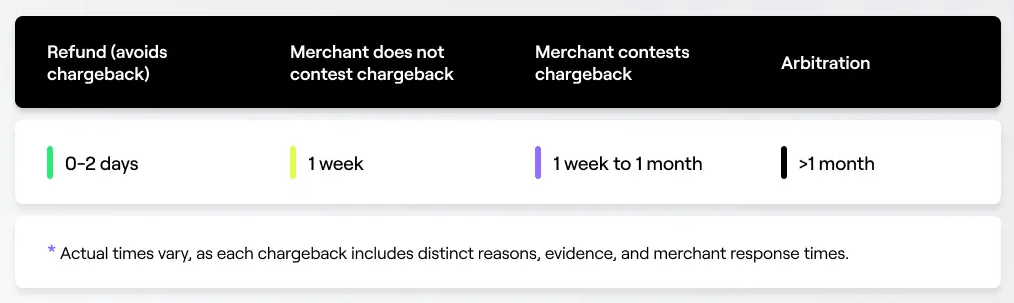
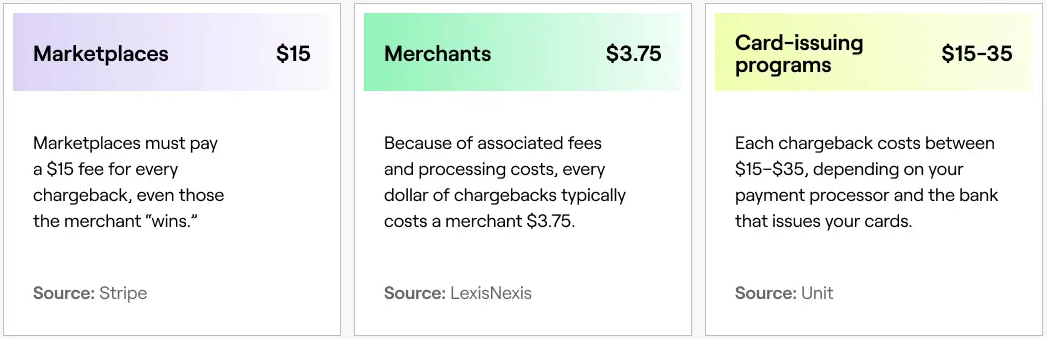
A chargeback is a forced reversal initiated by the cardholder's bank — not a refund you control. The bank pulls funds back from your account and charges a fee ($15–$30 per dispute) regardless of whether the underlying claim is legitimate.
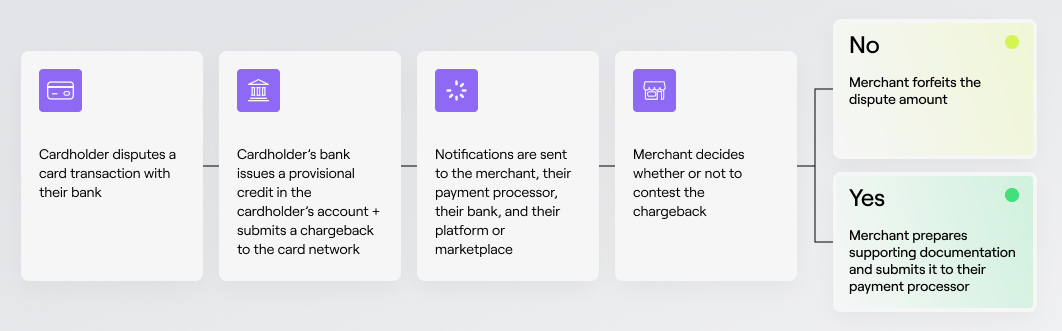
Your chargeback ratio — chargebacks as a percentage of total transactions — is a hard trigger with escalating consequences. Visa's monitoring program (VAMP) is tightening its "excessive" threshold to 1.5% in April 2026. A prudent internal red line is 0.9% — well below the network threshold, giving you room to react. Exceed network thresholds and consequences escalate from monitoring fees and mandatory reserves to account termination.
For platforms processing ACH payments, Nacha mandates strict return rate thresholds: 3% for administrative returns and 0.5% for unauthorized returns. Exceeding either puts your ACH processing privileges at stake.
Termination "for cause" — excessive chargebacks, fraud, PCI non-compliance, prohibited business — puts the business and its principal owners personally on Mastercard's MATCH list for five years. You are generally not notified when this happens; you find out when a new merchant application gets declined.
Compliance and regulatory risk
PCI DSS (Payment Card Industry Data Security Standard) applies to any business handling card data. Your compliance level is set by transaction volume. Level 1 (roughly 6M+ transactions/year) requires an annual on-site audit by a Qualified Security Assessor — a process costing $50K–$250K upfront and $30K–$80K annually to maintain. Most platforms avoid this entirely by using tokenized, hosted payment fields so card data never touches their own servers, typically qualifying for the lightest self-assessment tier (SAQ A).
KYC/KYB and AML/BSA require verifying the identity of every merchant and beneficial owner, monitoring transactions for suspicious activity, and filing Suspicious Activity Reports (SARs) and Currency Transaction Reports (CTRs) if you cross into money-services-business territory.
OFAC sanctions screening is strict liability — intent is irrelevant. Civil penalties run up to roughly $377,700 per violation or twice the transaction value, whichever is greater. Criminal willful violations run into the millions. Total OFAC penalties across the financial industry exceeded $265M in a recent year. Screening every merchant and beneficial owner at onboarding, and continuously afterward, is non-negotiable.
HIPAA applies to platforms serving healthcare merchants where patient data may be adjacent to payment flows. This is covered in depth in Part 4.
Operational risk
Operational risk comes from failures inside your own payment processing flow: integration errors, reconciliation gaps, third-party vendor outages, or misrouted transactions. The business impact includes delayed settlements, duplicate charges, and the manual cleanup costs that follow. Operational failures that expose card data can also trigger PCI enforcement.
Settlement and money transmission risk
If your platform ever holds customer funds before paying them out — rather than money passing straight through to the merchant — you can trigger state-by-state money transmitter licensing: surety bonds starting around $100,000, net-worth tests, NMLS filings, and multi-month review timelines per state. Most vertical SaaS platforms avoid this by structuring fund flows so a licensed partner is always the entity technically transmitting funds. Get a written legal opinion on your specific fund flow before you build it.
Payment finality risk is specific to irrevocable payment rails like FedNow and Real-Time Payments (RTP): once sent, these payments cannot be recalled or reversed, even if sent to a fraudster. Pre-send verification is the only real defense.
Reserves, holds, and freezes
Every processor's services agreement gives them broad discretionary rights to hold funds — up to 90 days routinely, up to 180 days when chargeback exposure remains possible — for risk, incomplete verification, prohibited products, or sudden volume spikes. A fast-growing merchant with $100K/day in sales and a 10% rolling reserve has $900K locked up after 90 days. This is a real working-capital constraint, and it's standard in every payment model.
Part 2: The Three Payment Models — What Each One Actually Transfers
With the full risk landscape mapped, here's what each payment model does and doesn't move off your plate.
Full PayFac registration: you own everything
If you register as a Payment Facilitator directly with Visa and Mastercard, you become the merchant of record for your entire sub-merchant portfolio. The liability profile is comprehensive:
- You absorb sub-merchant fraud and chargeback liability directly. Under Visa Core Rules §5.3.1.1 and equivalent Mastercard provisions, the PayFac is liable for all acts, omissions, and cardholder disputes of its sub-merchants. If a sub-merchant racks up chargebacks and disappears, you pay.
- You own KYC/KYB/AML end to end — identity verification, transaction monitoring, SAR/CTR filing, ongoing re-screening.
- You carry PCI DSS Level 1 certification yourself — $50K–$250K and 3–5 months to first certify, plus annual re-validation.
- You're exposed to money transmission licensing on a state-by-state basis if your fund flows make you a money transmitter.
- You hold network registration — $5,000 each with Visa and Mastercard — and maintain an ongoing sponsor-bank relationship.
- You and your principals are personally exposed to the MATCH list for any termination "for cause."
- You own tax registrations and filings for transactions processed under your merchant account.
Full registration also requires dedicated risk and compliance staff — a minimum team of 2–3 people runs $200K–$400K/year fully loaded — plus a formal AML program including a BSA officer and SAR filing capability.
PayFac-as-a-Service: meaningful transfer, with important limits
Under PFaaS (Stripe Connect, Adyen for Platforms, Finix, Payrix, Payroc, and similar), your merchants are onboarded as sub-merchants under the provider's master merchant account. The provider — not you — is registered with Visa/Mastercard, holds PCI DSS Level 1 certification, and is the technical merchant of record.
What the PFaaS provider genuinely takes off your plate:
- Regulatory registration with card networks and the sponsor-bank relationship
- KYC/AML checks on sub-merchants, executed at onboarding
- Direct chargeback liability and fraud losses
- PCI DSS Level 1 compliance infrastructure
- Settlement and payouts infrastructure
What your SaaS company still owns — the part most articles gloss over:
Merchant quality and intake. Even though the PFaaS provider runs automated KYC checks, you control who you're presenting to the platform for onboarding. If you're funneling bad merchants toward the PFaaS provider, that's on you contractually. A portfolio of high-chargeback sub-merchants drags down your standing with the provider regardless of who's technically liable — expect tighter underwriting, higher reserves, or being dropped as a partner if your book looks risky in aggregate.
Tax registrations and merchant-of-record exposure. PFaaS offloads payment risk, not tax liability. Your SaaS company is still the legal merchant in the transaction, and the obligations that flow from that — sales tax, VAT on applicable transactions, tax filings — remain with you.
Data handling before it reaches the provider. Your platform uses the provider's APIs to collect data from new sub-merchants, which means you're gathering that information and are responsible for how it's handled, stored, and transmitted before it reaches the PFaaS provider. If that data flow creates HIPAA exposure, that exposure is yours.
Acceptable use enforcement. A single high-risk sub-merchant operating outside acceptable use policies can trigger enforcement actions, fines, or registration revocation for the entire PayFac portfolio. The PFaaS provider will hold your platform contractually responsible for not actively onboarding or enabling bad actors.
OFAC sanctions screening. Strict liability that doesn't fully outsource regardless of model. Both you and your provider can face exposure if a sanctioned party transacts on your platform. Confirm that your provider's screening is actually running at onboarding and on a continuous basis — don't assume it is.
The support and reputational fallout of a freeze. When a processor freezes a merchant account, your platform fields the call, even though the decision was the provider's. The account freeze playbook in Part 6 covers this in detail.
PFaaS transfers the financial and regulatory payment infrastructure risk upward to the provider, but your SaaS company retains responsibility for who you let in, tax obligations, data handling, and contractual compliance with the provider's acceptable use terms. It's a meaningful reduction in risk, not an elimination of it.
Merchant of Record: maximum transfer, minimum control
A Merchant of Record provider — Paddle, Lemon Squeezy, and similar — steps in as the legal seller of record in the transaction entirely. They own the tax liability, the regulatory exposure, and the customer relationship at the point of payment.
What MoR takes off your plate that PFaaS does not:
- Tax registrations, filings, and exposure — VAT, sales tax, and local payment regulations country by country
- The legal merchant designation in the transaction
- Most compliance obligations that flow from holding merchant-of-record status
The trade-off: Control versus liability. PFaaS gives you more control over the payment experience and monetization — you earn a spread on every transaction — but you retain more legal exposure as the merchant. An MoR removes more exposure but you cede more of the payment relationship and economics to the provider.
When MoR makes sense: For SaaS companies selling internationally, MoR is often the more attractive option because the provider handles VAT, sales tax, and local payment regulations country by country — obligations that under PFaaS still fall entirely on you. For platforms operating primarily in the US with domestic sub-merchants, the economics of PFaaS are typically more favorable.
Part 3: The ROI Calculator — PFaaS vs. Full PayFac Registration
PFaaS costs more per transaction than running your own PayFac infrastructure. The question is whether that spread justifies the compliance and operational cost of registering yourself.
The cost structure of full PayFac registration
| Cost category | Annual range |
|---|---|
| PCI Level 1 certification (after initial build) | $30K–$80K/yr |
| Dedicated risk/compliance staff (2–3 people minimum) | $200K–$400K/yr |
| Sponsor-bank relationship management | $25K–$75K/yr |
| KYC/KYB/AML tooling and monitoring | $30K–$100K/yr |
| Legal and regulatory counsel | $25K–$75K/yr |
| Fraud tooling and chargeback management | $20K–$60K/yr |
| Network registration (one-time) | $10K |
Total ongoing annual cost: $330K–$790K/year, not including the initial build cost of $150K–$500K+ for the compliance and technical infrastructure.
The PFaaS spread
A typical PFaaS provider charges 25–50 basis points above what you'd pay as a registered PayFac (on top of interchange). At different volume levels:
| Annual GMV | 25 bps spread | 35 bps spread | 50 bps spread |
|---|---|---|---|
| $10M | $25K | $35K | $50K |
| $25M | $62.5K | $87.5K | $125K |
| $50M | $125K | $175K | $250K |
| $75M | $187.5K | $262.5K | $375K |
| $100M | $250K | $350K | $500K |
| $150M | $375K | $525K | $750K |
The break-even
At $100M in annual volume with a 35 bps spread, you're capturing approximately $350K in additional margin by registering as a PayFac — against a minimum annual compliance infrastructure cost of $330K. The math is roughly break-even at $100M, and starts working meaningfully in your favor only above $100M–$150M.
Where you land within that range depends on your vertical's fraud profile, how lean you can staff the compliance function, and whether the initial build cost has been amortized. Below $100M in annual GMV, the near-universal verdict — including from operators who've built full PayFac infrastructure in-house and regretted it — is to stay on PFaaS.
The residual economics question deserves more attention than most teams give it during vendor selection. A 20-point difference in residual split at $5M per month in GMV is $1.2M per year in platform revenue. That number should inform how much time and legal budget you allocate to the commercial negotiation — residuals are one of the few payments levers that compound without additional headcount.
What to negotiate in a PFaaS contract
Most founders sign the standard agreement and discover the leverage points only after something goes wrong. Four clauses are worth pushing back on specifically:
Indemnification scope. The default language in most PFaaS agreements makes you responsible for losses the provider incurs from your sub-merchants — effectively passing chargeback liability back to you even though the provider is the technical merchant of record. Push for a carve-out that limits your indemnification to losses caused by your own negligence or willful misconduct.
Reserve caps and release timelines. Standard agreements give the provider nearly unlimited discretion to set and maintain reserves. Negotiate a cap (10–15% of rolling 90-day volume is defensible) and a specific release schedule: reserves tied to a specific merchant should release within 90–120 days of that merchant's last transaction, not at the provider's indefinite discretion.
Termination notice requirements. Many agreements allow the provider to terminate with 30 days notice or less, and to pause payouts immediately upon notice. Push for 90 days notice for non-cause termination, and carve out any payout freeze so funds already earned continue to settle during the notice period.
Audit rights over fraud decisions. When the provider freezes a merchant account or applies a reserve, you typically have no right to see the underlying data driving that decision. Negotiate a right to receive a written explanation within 5 business days of any account action, and a defined escalation path with a named relationship manager — not just a support ticket queue.
Part 4: HIPAA and Payments — The Compliance Overlap Healthcare Platforms Get Wrong
Healthcare is one of the most misunderstood verticals for embedded payments because teams conflate payment compliance with healthcare compliance. They are two separate regulatory regimes, and both apply simultaneously if you're building payments infrastructure for medical practices.
When HIPAA applies to payment flows
A platform processing payments on behalf of medical practices does not automatically become a HIPAA covered entity purely because of payments. What matters is whether any protected health information (PHI) touches the payment flow.
In practice, practice management software often combines scheduling, patient records, and billing in a single interface. When a payment is initiated from that interface, the question of whether PHI crosses into the payment processor's system depends entirely on implementation. If your billing workflow passes a patient name, date of service, or procedure code to the payment processor as part of the transaction — even just in a metadata field — you have created a PHI data flow that triggers HIPAA obligations.
The practical implication: your platform needs to architect payment flows so that card data (governed by PCI DSS) and patient data (governed by HIPAA) remain in separate data streams that never commingle. This is an engineering constraint, not just a compliance checkbox, and it needs to be designed before the first line of payment integration code is written.
Business Associate Agreements (BAAs)
If PHI is adjacent to your payment flow in any configuration, you need a Business Associate Agreement with your PFaaS provider. A BAA is a contract that establishes HIPAA-compliant data handling obligations for a vendor that processes, transmits, or stores PHI on behalf of a covered entity.
Most general-purpose PFaaS providers do not offer BAAs as a standard term — Stripe's public documentation explicitly notes it does not sign BAAs in most standard configurations. Healthcare-focused providers like Finix and Stax Connect have addressed this at the infrastructure level by supporting data separation and offering BAA documentation for appropriate configurations.
If your PFaaS provider won't sign a BAA and your implementation creates PHI adjacency, you are operating outside HIPAA compliance regardless of how your payments contract reads. This is not a risk you can paper over with legal language.
Assuming PCI compliance covers HIPAA, or vice versa. They govern different data types, have different enforcement mechanisms, and are administered by different bodies. A platform can be fully PCI compliant and simultaneously HIPAA non-compliant if patient data is handled incorrectly adjacent to card flows.
Practical requirements for healthcare platforms
- Never let card numbers appear alongside patient identifiers in the same data record, API call, or log entry
- Ensure call recordings and CRM notes do not capture card numbers spoken aloud — use DTMF masking for phone-based payment capture
- Require a signed BAA from any vendor in the data flow who may touch PHI — including your PFaaS provider, your KYC/identity vendor, and your data warehouse if payment and patient data are ever joined
- Audit your integration architecture for PHI/PCI data commingling before onboarding your first healthcare merchant, not after
Getting this wrong is not just a regulatory problem. It is a merchant churn accelerant: healthcare practices that discover their payment provider is not configured correctly will leave quickly, and the remediation cost — re-architecting the data flow after the fact — is substantially higher than designing it correctly from the start.
Part 5: Fraud in Practice — What's Actually Hitting Platforms Right Now
Understanding the fraud landscape is practical, not academic, because each fraud type has a different prevention mechanism and a different cost profile.
Friendly fraud is now the dominant category. It's "friendly" because it's initiated by your actual customer — typically someone who forgot about a recurring charge and called their bank instead of your support line. It counts against your chargeback ratio exactly like stolen-card fraud. The most effective defense is operational: clear merchant descriptors that customers recognize on their statements, proactive email reminders before recurring charges, and a frictionless cancellation path that eliminates the motivation to dispute through the bank.
Card testing is automated and fast. A single attack can generate thousands of authorization attempts in hours. Rate limiting and velocity checks on any card-on-file flow are baseline defenses. If you offer free trials that require a card, you need bot detection on that form.
Account takeover is the fastest-growing category. Fraudsters target accounts that already passed KYC — which is exactly the accounts on your platform. Multi-factor authentication on merchant accounts is not optional at any meaningful scale.
Synthetic identity fraud passes standard KYC. This is why the merchant intake responsibility that stays with you under PFaaS matters: behavioral signals — a "software company" expecting $200K/month in volume on day one, with a personal Gmail and no web presence — are often more reliable than document checks for this fraud type.
Chargeback monitoring: the metrics that matter
Most founders open the processor's fraud dashboard once at setup and don't return until something breaks. These metrics are worth reviewing weekly:
Dispute rate by sub-merchant. Sort by dispute rate, not dispute count, so a low-volume merchant with 8% disputes surfaces above a high-volume merchant with 0.8%. Any sub-merchant above 1% deserves a manual review; above 2% is an offboarding conversation.
Early Fraud Warnings (EFWs). Card networks notify merchants when a cardholder has reported fraud, typically 24–72 hours before a formal chargeback is filed. Proactively refunding a transaction flagged by an EFW loses you that transaction's revenue but avoids the chargeback counting against your ratio. This is one of the highest-leverage, most underused interventions available.
Authorization decline rate. A baseline decline rate of 5–15% is normal depending on your vertical. A sudden spike above 20–25% often signals either a card-testing attack inflating attempt volume or an issuer starting to decline your BIN for risk reasons — both require immediate action.
Velocity alerts. Review and tune these quarterly. The defaults are calibrated for an average merchant, not your specific transaction patterns.
Part 6: The Account Freeze Playbook
A processor freeze is operationally survivable if you've prepared for it. It's existential if you haven't. Every processor's services agreement gives them broad discretionary rights to pause payouts or freeze funds — for risk flags, incomplete verification, prohibited products, or sudden volume spikes.
In the first hour
- Pull the processor notification and identify what triggered the freeze: risk flag, incomplete KYC, chargeback threshold breach, volume spike, or prohibited business category. Each has a different resolution path.
- Contact your processor's risk team directly — not general support. If you negotiated a named relationship manager in your contract, this is when that matters.
- Notify the affected merchant proactively, before they discover the freeze themselves.
In the first 24 hours
- Gather the documentation the processor is requesting: updated KYC, business verification, explanation of a volume spike, or evidence that a disputed transaction was legitimate.
- If the freeze is unresolved after 24 hours and you have a backup processor relationship, begin routing new transactions there. Don't wait for resolution before activating the backup.
- Document everything: timestamps, names, what you submitted and when. This record matters for escalation and for any future dispute about hold duration.
Resolution timelines to expect: Freezes tied to incomplete KYC typically resolve in 3–7 business days once documentation is submitted. Risk-flagged freezes tied to chargeback spikes can run 30–60 days. Freezes for prohibited business are often permanent — the merchant will need a different processor.
"Your processor has applied a temporary hold while they review [specific issue]. We've submitted the required documentation and expect a response within X days. In the meantime, here's what you can do."
Merchants who feel informed stay; merchants who feel blindsided churn and post about it.
The backup processor requirement: Keep a backup processor relationship live and functioning — not just contracted — before you need it. If you haven't run a test transaction through your backup processor in the last 90 days, it's not actually live.
Part 7: Merchant Onboarding — Your First Line of Defense
Your intake process is the single point where you can prevent most downstream fraud, chargeback, and compliance problems. Because merchant selection remains your responsibility under PFaaS, this deserves more operational attention than most platforms give it.
Minimum viable onboarding checklist
Every merchant at onboarding:
- Legal business name, DBA if applicable, EIN/tax ID
- Business address (physical, not P.O. box) verified against a third-party database
- Business type and MCC code confirmed against your approved category list
- At least one beneficial owner (25%+ ownership) identity verified — name, DOB, SSN last 4
- All beneficial owners and the business entity screened against the OFAC SDN list
- Signed merchant agreement including your acceptable use policy
- Continuous OFAC re-screening confirmed active in your provider's system
Before a merchant exceeds $10K/month in processing volume:
- Full beneficial owner identity verification — government-issued ID for any owner >25%
- Business verification document (articles of incorporation, business license, or equivalent)
- Website reviewed manually — confirm the products/services match the MCC and are permitted
- Bank account verification (micro-deposit or instant verification)
- Chargeback history from prior processor if they're switching (ask for last 6 months)
For healthcare merchants specifically:
- NPI number for any provider billing for clinical services
- BAA signed with the PFaaS provider confirmed before onboarding
- Confirmation that payment flow architecture keeps PHI and card data separated
- Confirmation the merchant maintains their own HIPAA-compliant billing practices
Red flags that warrant extra scrutiny
Any merchant expecting very high volume relative to business age. A "software company" expecting $200K/month in month one with no website, no LinkedIn presence, and a personal Gmail address deserves a phone call before approval. This pattern is associated with both synthetic identity fraud and card testing setups.
Merchants switching processors without explaining why. The most common reason merchants switch processors is a chargeback problem at the prior processor. Ask for their last 6 months of processing history before approving.
Healthcare applications without mention of their EHR or billing system. Legitimate healthcare practices almost always have one. An application that doesn't mention it warrants a follow-up call.
Setting merchant expectations about reserves upfront
Reserves are a known feature of payments processing, but most platforms treat them as something that happens to merchants rather than something merchants are prepared for. This creates unnecessary support load and churn.
In your merchant agreement: Include a clause explicitly describing your processor's right to apply reserves, typical reserve rates (5–10% of daily settlement), and maximum hold periods (90–180 days).
In your merchant onboarding flow: Add a brief disclosure at signup: "Payments are typically settled within 2 business days. Your processor may hold a portion of settlements as a reserve during the first 90 days of processing or during periods of elevated dispute activity. This is standard across payment processors and is returned once the hold period expires."
When a reserve is applied: Notify the merchant before they discover it in their dashboard. Explain specifically what triggered it, what percentage is being held, and when it will be released.
FAQ
Under PFaaS, your provider is the technical merchant of record — they hold the network registration, PCI Level 1 certification, and absorb direct chargeback liability from fraud their underwriting failed to catch. You still own tax obligations, merchant intake quality, data handling, and acceptable use enforcement. As a full PayFac, you are the merchant of record for your entire sub-merchant portfolio and own all of the above plus the compliance infrastructure. The dividing line in practice: PFaaS below ~$100M–$150M/year, full registration only once that volume can justify the compliance infrastructure cost.
A PFaaS provider handles payment infrastructure, compliance, and chargeback liability, but your SaaS company is still legally the merchant in the transaction — you own tax registrations, filings, and exposure. A Merchant of Record steps in as the legal seller in the transaction entirely, taking on tax liability, regulatory exposure, and the customer relationship at the point of payment. MoR makes the most sense for platforms selling internationally where per-country tax compliance would otherwise fall on you.
The security standard for any business that handles card data. Your compliance level is set by annual transaction volume. Level 1 (roughly 6M+ transactions/year) requires an annual on-site audit by a Qualified Security Assessor. Most platforms avoid this entirely by using tokenized, hosted payment fields so card data never touches their own servers — this typically qualifies for the lightest self-assessment tier (SAQ A).
A chargeback is a forced reversal initiated by the cardholder's bank — the bank pulls funds back from your account and charges a fee ($15–$30) regardless of whether the claim is legitimate. A refund is something you initiate voluntarily. Every chargeback counts against your chargeback ratio; a proactive refund does not.
A portion of daily settlement (typically 5–10%) withheld by the acquirer for 90–180 days as security against future chargebacks. It's a real working-capital constraint: a merchant with $100K/day in sales and a 10% rolling reserve has $900K locked up after 90 days. Reserves are generally negotiable downward once you've built a track record of low chargebacks.
A notification from the card network that a cardholder has reported fraud, sent 24–72 hours before a formal chargeback is filed. Proactively refunding a transaction flagged by an EFW avoids the chargeback counting against your ratio entirely. It's one of the highest-leverage interventions available — and it's often sitting unmonitored in the processor dashboard.
Only if your fund flows involve holding customer funds before paying them out, rather than money passing through to the merchant without your platform taking custody. Most vertical SaaS platforms structure around this by using a licensed partner as the entity that technically transmits funds. Get a specific legal opinion on your fund flow — this is fact-specific enough that generic guidance isn't a substitute for counsel.
OFAC (Office of Foreign Assets Control) maintains a list of sanctioned individuals, entities, and countries that US persons and companies are prohibited from transacting with. Screening against this list is strict liability — intent is irrelevant. While your PFaaS provider will run their own OFAC screening, both you and your provider can face exposure if a sanctioned party transacts on your platform. You need to verify that continuous re-screening is actually happening in your provider's system, not just assume it is.