
Payment Processing Fees Explained: What Your Merchants Actually Pay, and Why
Card fees are three separate charges paid to three different parties. Only the smallest one is negotiable.
Card processing fees are not a single number — they are three separate charges, stacked on top of each other, paid to three different parties. For a vertical SaaS company embedding or reselling payments, the difference between understanding this structure and accepting a blended quote is the difference between optimizing a real cost and shopping for an illusion. According to Swipesum's 2026 merchant cost analysis, real merchant effective rates routinely diverge from headline rates by 30 to 80 basis points — and independent statement audits regularly surface that difference. The only part of the stack that's actually negotiable is the smallest piece.
- Card processing fees have three layers: interchange (to the issuing bank, typically 1.5%–2.4%+), scheme fees (to the card network, roughly 0.14% for Visa), and processor markup — the only negotiable piece, which on a $2.50 fee for a $100 sale is roughly $0.71.
- The US interchange system has approximately 1,000 rate categories; a basic debit card can carry interchange under 0.5% while a premium rewards card can run above 2.4% — the card type alone moves the cost by multiple percentage points.
- Transactions that fail to qualify for their correct interchange category silently downgrade to a more expensive one; independent audits commonly find businesses overpaying by 30–80 basis points versus what their actual card mix should cost.
- Level 2/3 data passthrough can save B2B platforms tens of thousands of dollars a year on $1M/month in corporate card volume; most consumer-focused processors, including Stripe, do not configure this automatically.
- A $10,000 B2B invoice costs roughly $5 via ACH versus $290 via card at a 2.9% rate — for construction, field services, or property management platforms, offering ACH is the single highest-leverage cost lever available.
The three pieces of every card fee
When a customer pays $100 with a credit card, the merchant doesn't receive $100 minus one fee — they receive $100 minus three separate charges, paid to three different parties.
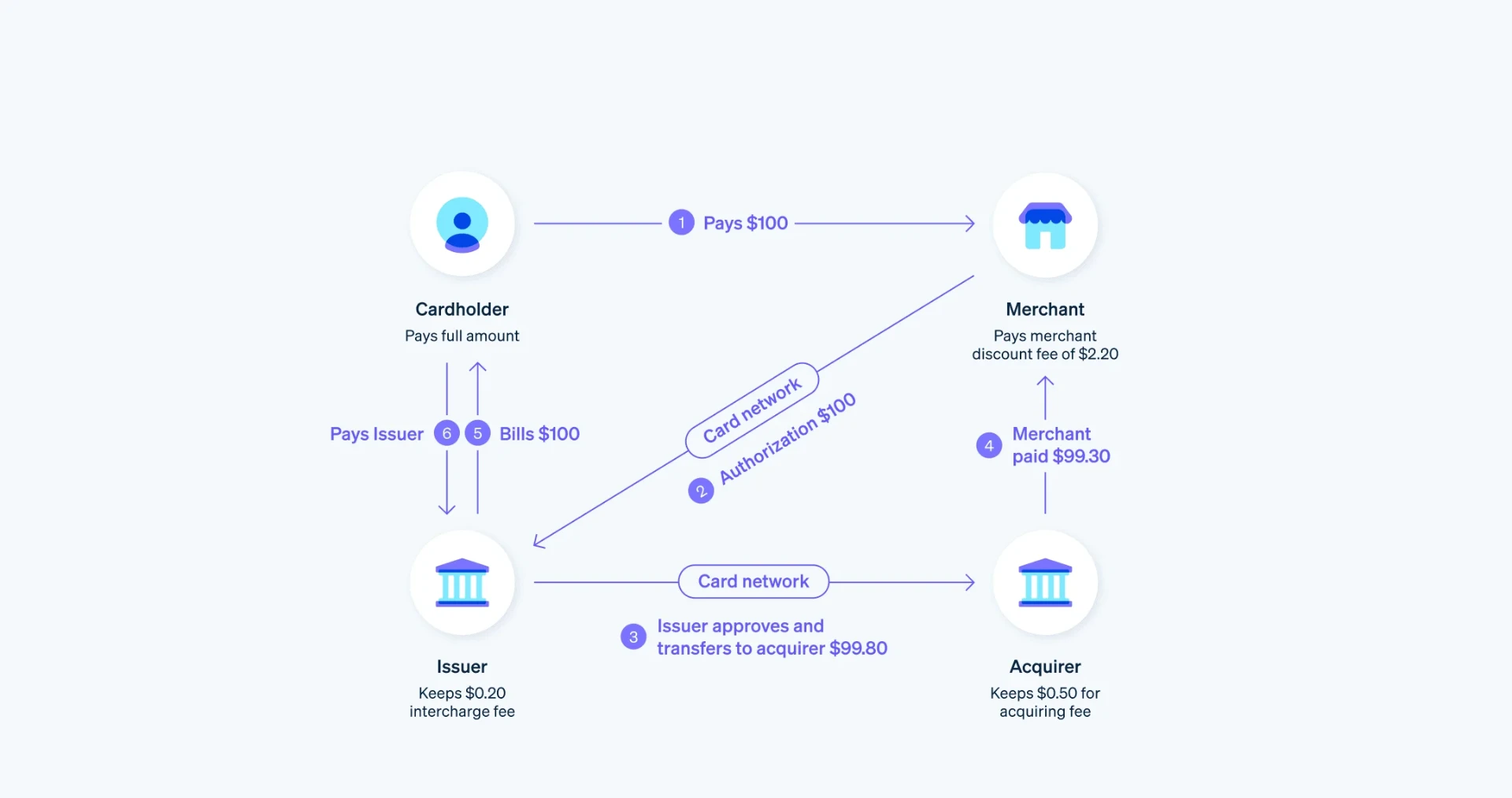
- Interchange goes to the cardholder's issuing bank (Chase, Capital One, Citi). It's the largest piece — typically 1.5% to 2.4%+ depending on the card — and it compensates the issuer for fraud risk, funding the rewards program, and carrying the credit. Visa and Mastercard set it twice a year, publish it in dense rate tables, and it is identical no matter which processor the merchant uses. It cannot be negotiated, and switching processors does nothing to it.
- Scheme fees (assessments) go to the card network itself. Visa charges roughly 0.14% on credit transactions; Mastercard charges approximately 0.1375% plus a small flat fee. This is the toll for using the network's rails. Also non-negotiable, also identical everywhere.
- Processor markup is the only piece that's actually negotiable — and it's the piece most pricing structures are designed to obscure. On a $100 sale with a $2.50 total fee, roughly $1.65 goes to the issuing bank, $0.14 goes to Visa, and $0.71 is the processor's margin. Switching processors or shopping for a better deal only ever moves that last $0.71. It does nothing to the $1.79 in pass-through cost underneath it.
Most of what merchants pay is fixed by the card networks, not by whoever they buy processing from. When a merchant says "I want to shop around for a better rate," what they can actually shop for is a smaller markup — usually a fraction of the total bill.
Why the effective rate is never a single number
The US interchange system isn't a single rate — it's approximately 1,000 different rate categories, and every transaction gets sorted into one of them based on details most merchants never see: the card type (basic debit vs. premium rewards vs. corporate), whether it was swiped or keyed in, whether the transaction data was complete, and how quickly it settled. A basic debit card can carry interchange under 0.5%; a premium travel rewards card can run above 2.4% — a gap of multiple percentage points on transactions that look identical to the customer. The reason debit rates sit so low is regulatory: the Federal Reserve's Regulation II (Durbin Amendment) caps interchange for debit cards issued by banks with more than $10B in assets at roughly 21¢ base plus 0.05% per transaction; per 2024 Federal Reserve data, covered issuers average approximately 23¢ per transaction versus roughly 51¢ for exempt issuers.
This is why "my rate is 2.9%" is a convenience, not a fact. It's an average across hundreds of underlying categories, and the actual category a given transaction lands in is decided by inputs on your side: what card the customer used, what data was passed, and whether everything settled cleanly.
When a transaction fails to qualify for the rate it was eligible for, it downgrades to a more expensive category — silently. The transaction still goes through; the customer notices nothing; the only trace is a slightly higher line item buried in a statement. Common causes include a corporate card processed without Level 2/3 enhanced data, a transaction that settled a day late, or a missing verification field. Individually these are cents. Summed across a year of volume, they're real money. Because blended-rate statements report only the final averaged number, most platforms never see the leak at all. Independent statement audits commonly find businesses overpaying by 30 to 80 basis points versus what their actual card mix and volume should cost.
Level 2 and Level 3 data is the fix for B2B specifically. Corporate and commercial cards qualify for meaningfully lower interchange when the transaction includes extra fields — Level 2 adds a customer reference code, tax amount, and merchant postal code; Level 3 adds full line-item detail (product codes, quantities, unit prices).
A B2B SaaS platform whose customers pay with corporate cards but hasn't configured Level 2/3 passthrough is routinely leaving money on the table. The gap between standard and Level 3 rates on $1M/month in corporate card volume can run tens of thousands of dollars a year. Most consumer-focused processors — Stripe, Square — don't pass this data automatically; it must be configured explicitly.
The four pricing models and which one hides the number
There are effectively four ways processors price this stack, and they are not equivalent.
Flat-rate / blended pricing — the Stripe, Square, and PayPal model — charges one rate for every transaction (2.9% + $0.30, for example) regardless of the underlying interchange. It's simple and predictable, which is genuinely valuable for a new, low-volume business. But simplicity is the cost: a debit transaction that costs the processor a few basis points and a premium rewards transaction that costs far more get billed identically, averaged high enough that the processor wins on the blend. Below roughly $1M/month in volume, this simplicity is usually worth the premium; above it, the averaging compounds into real money, especially for merchants whose customers skew toward debit.
Interchange-plus (IC++) separates the bill into its real components: actual interchange, scheme fees, and a fixed, visible processor markup. It's the most transparent structure and, for any business doing meaningful volume, almost always the cheapest — because you can actually see and negotiate the one number that's negotiable.
Tiered pricing buckets transactions into "qualified," "mid-qualified," and "non-qualified" rates that look simple but are engineered to be murky. The processor decides which bucket a given transaction lands in, and a card quoted at a 1.5% "qualified" rate can quietly settle at 3.5% because of a rewards card or incomplete data. This model exists to extract margin, not to inform the merchant.
Subscription/membership pricing (Stax's model) charges a flat monthly fee plus a small flat per-transaction cost, with no percentage markup at all. For high-volume, high-average-ticket merchants this can be the cheapest structure available — the risk is a monthly fee that can be raised with little notice.
The practical test: if a statement shows one blended percentage and nothing else, you cannot see whether transactions are qualifying at the rate they're entitled to. Transaction-level data is required to check that, and no processor is incentivized to hand it over unprompted.
A platform processing $10M/year across 200,000 transactions at an average ticket of $50 pays roughly $350,000/year under flat-rate pricing (2.9% + $0.30). The same volume under a negotiated interchange-plus structure — 1.4% interchange + 0.13% assessments + 0.5% markup + $0.10 per transaction — costs roughly $223,000/year.
That's a $127,000/year difference. The flat rate wasn't hiding a tiny inefficiency; it was hiding a markup roughly three times the size of the negotiated one.
What Stripe and comparable providers actually cost beyond the headline rate
Stripe's advertised 2.9% + $0.30 for online payments is close to accurate only for a narrow case: a US business, taking US-issued cards, using no add-on products. The moment products stack, so does the rate:
- ACH direct debit: 0.8%, capped at $5.00 — a $10,000 invoice costs $5 via ACH versus $290 via card.
- Instant payouts: 1.5% of the payout amount (minimum $0.50).
- Disputes: $15 per chargeback filed; as of June 2025, a second $15 "dispute countered fee" applies if contested and lost — up to $30 total for a fully contested, lost dispute.
- International cards: +1.5% on top of the base rate.
- Currency conversion: +1% if Stripe converts the currency.
- Connect platform payouts: 0.25% + $0.25 per payout to each connected account — a platform paying out $10M/month across 1,000 sub-merchants pays roughly $25,000/month here alone.
According to independent analyses of real merchant statements reviewed by Swipesum (2026), stacking subscriptions, international customers, and currency conversion has produced blended effective rates as high as 7.8% — nearly three times the headline number. The number to track is the effective rate: total fees divided by total volume, not the number on the pricing page.
Card network fee ranges at a glance
The table below shows typical fee ranges and primary cost drivers for the four major card networks. All data sourced from Stripe's published interchange documentation.
| Card network | Typical fee range | Network model | Primary cost drivers | Regional restrictions |
|---|---|---|---|---|
| Visa | 1.15% + 10¢ to 2.70% + 10¢ | Open-loop | Card tier (Classic vs. Signature Preferred), capture method, Merchant Category Code | Consumer cards capped at 0.30% in EU, 0.50% in Australia |
| Mastercard | 1.15% + 10¢ to 2.60% + 10¢ | Open-loop | Interchange program tier (Core vs. World Elite), industry classification, transaction risk | Consumer cards capped at 0.30% in EU, 0.50% in Australia |
| Discover | 1.40% + 5¢ to 2.40% + 10¢ | Closed-loop / hybrid | Card category (Core Consumer vs. Rewards), specific payment processing acceptance criteria | Primarily domestic U.S.; international fees depend on local network alliances |
| American Express | 1.43% + 10¢ to 3.30% + 10¢ | Closed-loop | Explicit merchant industry group, overall settlement transaction size | Operates under distinct corporate pricing rules; less subject to domestic open-loop caps |
Source: Stripe interchange documentation.
Why vertical SaaS platforms are now the reason rates go up
This matters directly for a vertical SaaS operator, on both sides of the transaction. Historically, merchants were sold processing by independent sales agents who competed on price — if one agent's markup got greedy, a competitor undercut them. That competitive pressure kept markups honest.
That model has shifted into software. The point-of-sale system, the booking platform, the practice management tool — increasingly the front door to payments — has every incentive to monetize the transactions flowing through it. Under a referral arrangement, a software vendor keeps roughly 30–50% of processing revenue; as a payment facilitator owning the merchant relationship directly, that share jumps to 70–90%. That extra margin comes out of the end merchant's transactions.
This cuts both ways for a vertical SaaS operator: it's the mechanism behind the embedded payments monetization opportunity, and it's also why merchants on any embedded-payments platform will increasingly — and correctly — suspect their software vendor of pricing payments as a profit center rather than a pass-through utility. Transparency about what's being marked up, and why, is becoming a real trust variable, not just a compliance nicety.
What the monetization actually looks like in practice: at $250K/month in GMV, a platform capturing 60 bps gross minus 20 bps in operational costs nets roughly $1,000/month in payment revenue. At $1M/month GMV, the same math at 70 bps gross minus 15 bps yields roughly $5,500/month. At $5M/month, 90 bps gross minus 10 bps in ops yields roughly $40,000/month. The difference between a 20 bps and 60 bps spread at $1M/month is approximately $4,000/month in gross profit — which is why the structural decision (Stripe Connect application fee vs. PFaaS spread) compounds quickly as volume grows. Mindbody earns approximately $150/month per customer from software and another $100/month from embedded payments; ServiceTitan's December 2024 IPO filings showed revenue split as 71% subscription, 25% usage-based fintech, and 4% services — a split that reflects what happens when a vertical SaaS platform gets the payments infrastructure decision right early.
The cheapest lever most platforms are underusing: ACH
Every dollar routed through ACH instead of cards saves roughly the same order of magnitude: cents instead of percent. A $10,000 B2B invoice costs about $5 to move via ACH (Stripe charges 0.8%, capped at $5) versus $290 via card at a 2.9% rate. For any vertical where invoices run large — construction, field services, B2B SaaS billing, property management — offering ACH isn't a nice-to-have. It's usually the single highest-leverage cost lever available, more impactful than any amount of interchange optimization on the card side.
The tradeoff is settlement speed (1–3 business days versus seconds) and return risk: ACH can bounce back days after the transfer initiates.
Surcharging: when to make the customer pay the card fee
Surcharging adds a fee — typically 2–3% — specifically when a customer pays by credit card, shifting the processing cost onto the customer who chose that payment method rather than absorbing it into margin. For a business processing $500,000/year in card volume, unrecovered card fees run $10,000–$20,000/year; surcharging is the direct offset.
The mechanics, in order
- Calculate the surcharge (typically 2–3% of the transaction).
- Disclose it clearly before the customer completes payment.
- Let the customer choose an alternative (debit, ACH, cash) to avoid it.
- Show it as a separate line item on the receipt.
The rules that actually matter
- Visa caps surcharges at 3%. Mastercard technically allows up to 4% but only if the merchant's actual cost of acceptance justifies it — 3% is the safe ceiling across all networks.
- The surcharge can never exceed actual cost of acceptance. Calculate it as total processing fees ÷ total card sales for the past 2–3 months.
- Debit and prepaid cards can never be surcharged. This requires real-time BIN lookup at checkout to detect the card's actual funding type.
- Mastercard requires 30 days' advance registration before surcharging begins.
- Refunds must prorate the surcharge. This is the single most commonly missed implementation detail, and both Visa and Mastercard have explicit rules requiring it.
- State law adds a second layer. Surcharging is prohibited outright in Connecticut, Maine, Massachusetts, and other states (verify current status — the list changes). Several more states, including California, New York, Minnesota, and Mississippi, have ambiguous or specific disclosure requirements.
Surcharging works cleanly for B2B and high-ticket merchants. It's riskier for consumer-facing, price-sensitive retail. Mastercard suspended and is rewriting its surcharging rules in 2026 — any platform building this at scale should use a dedicated compliance engine rather than hand-rolled logic. The rules change often enough that manual maintenance is a genuine ongoing burden.
Cash discounting achieves the same economic outcome from the opposite framing: post a higher "regular" price, then discount it for customers who pay by cash, ACH, or debit. It's treated differently under some state laws and is common in states where surcharging itself is legally ambiguous.
The fixed and hidden fees that add up separately from the percentage rate
Beyond the interchange/scheme/markup stack, a standard processing agreement typically layers on:
- PCI compliance fee: ~$99–$199/year, sometimes billed monthly.
- PCI non-compliance fee: ~$19.95–$99/month if the merchant hasn't filed their self-assessment questionnaire — up to $240–$720/year for a paperwork gap, regardless of actual security posture.
- Monthly minimums and statement fees: ~$10–$25/month, which penalize low-volume merchants disproportionately.
- Batch/settlement fees: ~$0.10–$0.25 per batch.
- Cross-border/international fees: typically an additional 1–1.5% on top of the base rate.
- Reserves — not a fee, but a real cash-flow cost that most platforms underestimate. Processors hold a percentage of processing volume as security against chargebacks and fraud, and that money sits off your balance sheet until released. There are three types: a rolling reserve (typically 5–10% of each deposit held for approximately 180 days, released on a rolling basis); a capped reserve (withholding until a cap — often 50–100% of one month's volume — is reached, typically not released until account closure); and an upfront reserve (a lump sum required before processing begins). Reserves are most common for higher-risk MCCs and are routinely imposed by PayFac-as-a-Service providers on new platforms. They are often negotiable down after 6–12 months of clean processing history.
None of these show up in a headline rate quote, and all of them are common enough that asking any prospective processor to itemize them explicitly — rather than accepting a single blended number — is standard due diligence.
Stripe Connect vs. PayFac-as-a-Service: the structural decision most platforms face too late
For most vertical SaaS platforms, the real infrastructure decision isn't which pricing model to negotiate — it's which payment model to operate under at all. Two options dominate at the $3M–$30M ARR stage.
Stripe Connect is the fastest way to launch embedded payments: no setup fee, roughly 3–4 weeks to integrate, and Stripe absorbs the heavier compliance and underwriting burden. The platform monetizes through an application fee layered on top of Stripe's rate.
PayFac-as-a-Service (PFaaS) — providers include Finix, Payrix (Worldpay), Infinicept, and Adyen for Platforms — lets a platform negotiate a wholesale buy rate and keep the spread. Typical net take rates run 30–100 bps above the buy rate. The trade-off is operational: the platform inherits underwriting responsibility, chargeback liability, reserves, PCI scope, and 1099-K duties. It's meaningfully more to manage.
The crossover point is roughly $500K–$1M/month in processing volume. Below it, Stripe Connect's simplicity usually wins. Above it, a 30–50 bps improvement in net take — roughly $1,800–$5,000/month at $1M GMV — typically outweighs the added operational cost. According to Rainforest's 2026 Embedded Payments Benchmark, platforms under $50M in processing volume run median take rates of 0.46–0.60%; above $250M, the median roughly doubles to 0.91–1.05%. The margin that separates those bands is almost entirely the structural question of which model the platform chose and when.
Full PayFac registration — card-brand registration, money-transmitter licensing, PCI Level 1 audit — carries setup costs commonly cited at $500K–$5M and 12–24 months of build time. It only pencils out at very high volume. PFaaS is the right intermediate step: it validates the economics and builds operational muscle before committing to registration.
Renegotiate or switch: how to think about it
When processing costs feel high, the instinctive move is to shop for a new processor. That's often the wrong first step. The right first question is: how much of the cost is even addressable, and by which lever?
Split the cost into two buckets. Interchange and scheme fees are pass-through — fixed by the networks, identical everywhere, unmovable by switching. Processor markup, revenue-share terms, and unshared fee categories are structural — genuinely negotiable, and often where the real recoverable money sits. A renegotiation with the current provider can often close most of the addressable gap with zero migration risk, because the incumbent has every incentive to keep your volume once they know you understand the real numbers.
Switch when: a competitive bid proves a materially better markup exists and the incumbent won't move, or you need a capability the incumbent genuinely lacks — a PayFac model, better routing, or specific rails.
Stay and renegotiate when: the gap between your rate and market is mostly closable by the incumbent, because migration is not free. Rebuilding the integration and moving an entire merchant portfolio without dropping transactions takes real effort, and that migration risk can erase paper savings if it's not run carefully.
Are you being paid correctly? An audit checklist
If a platform earns a residual or revenue share from a processing partner, don't assume the monthly statement they send is accurate — it's the processor's version of the math, not an independent check of it. In practice, a meaningful share of platforms are not being paid what their own contract entitles them to, for mundane reasons: a fee category that should have been shared and wasn't, a volume threshold that was supposed to trigger a rate step-down and silently didn't fire, transactions downgrading to a more expensive interchange category without anyone catching it.
To verify correct payment, check four things against raw settlement data — not the summary report:
- Does the residual/revenue-share split match the contract, on actual settled volume, to the cent?
- Is the platform being credited for every fee category the contract entitles it to share in?
- Did negotiated volume thresholds and rate step-downs actually fire when conditions were met?
- Are transactions qualifying at the interchange category they're actually entitled to, or silently downgrading?
Being paid correctly is the floor, not the ceiling — it only confirms you're getting what you negotiated, not that what you negotiated is competitive for your size and vertical.
If you run a vertical SaaS platform with embedded or referred payments and you're not certain whether you're paying the right effective rate — or earning the right residual — Bridges can review your processing economics before you renegotiate or expand your payment stack.
FAQ
Interchange goes to the issuing bank; scheme fees go to the card network (Visa, Mastercard). MDR — merchant discount rate — is the total all-in percentage the merchant pays: interchange plus scheme fees plus processor markup. Only the markup portion is negotiable.
Interchange-plus (IC++) separates the bill into real components — interchange, scheme fees, and a visible markup — rather than blending them. It's usually cheaper at meaningful volume, but below roughly $1M/month in processing, the simplicity of flat-rate pricing is often worth the small premium.
A downgrade means a transaction qualified for a more expensive interchange category than it should have — because required data was missing, settlement was late, or verification data wasn't passed. The transaction still processed; the merchant just paid more, with no notification.
Yes — by an order of magnitude on large transactions. A $10,000 B2B invoice costs roughly $5 via ACH (Stripe charges 0.8%, capped at $5) versus roughly $290 via card at a 2.9% rate. The tradeoff is settlement speed (1–3 business days) and return risk, not cost.
Level 2 and Level 3 data are enhanced transaction fields — customer reference codes, tax amounts, and line-item detail — that qualify B2B and corporate-card transactions for lower interchange rates. Most consumer-focused processors, including Stripe, don't pass this data automatically; it must be configured explicitly.
It depends on the merchant base. Surcharging works cleanly for B2B and high-ticket verticals; it's riskier for consumer-facing, price-sensitive retail. The compliance layer — Visa's 3% network cap, state law, refund proration, real-time debit-card detection — is substantial enough that most platforms use a dedicated compliance engine rather than hand-rolled logic.